By the time many of my patients bring up a change in their bleeding, they have already talked themselves out of it. They have heard — sometimes from friends, sometimes from a rushed appointment years ago — that irregular periods are just part of getting older. So they wait. They track it in their head, decide it is probably nothing, and move on.
Most of the time, they are right that the change is expected. But "expected" and "nothing worth checking" are not the same thing. Perimenopause genuinely does reshape how you bleed. It also happens to fall in the exact window of life when a few specific bleeding patterns deserve a real look — not because something is likely wrong, but because when something is wrong, catching it early changes everything.
This is the distinction I want every patient to walk away with. Not fear. Just a clear sense of what to expect, what to mention, and what should never wait.
What Actually Happens to Bleeding in Perimenopause
Perimenopause is the transition between your usual menstrual cycles and your final period. It can last several years, and during that time your hormones stop moving in the predictable rhythm they held for decades. That shows up in your cycle in ways that are completely normal.
According to the American College of Obstetricians and Gynecologists (ACOG), the common changes include:
- Cycle length shifting — periods coming closer together or further apart than what has always been normal for you
- Skipped periods — going a month or two without one, then having it return
- Flow changing — some periods noticeably lighter, others heavier than you are used to
- Timing becoming unpredictable — the reliable calendar you once had simply stops being reliable
If this is what you are experiencing, you are not doing anything wrong, and your body is not broken. This is the transition working the way it usually does.
Here is the part that gets lost, though: ACOG is equally clear that even normal-seeming changes are worth reporting to your clinician. Not because every change is a problem, but because some problems first announce themselves as "just another irregular period." The only way to tell the difference is to say it out loud to someone who can look.
Expected, Worth Discussing, or Urgent?
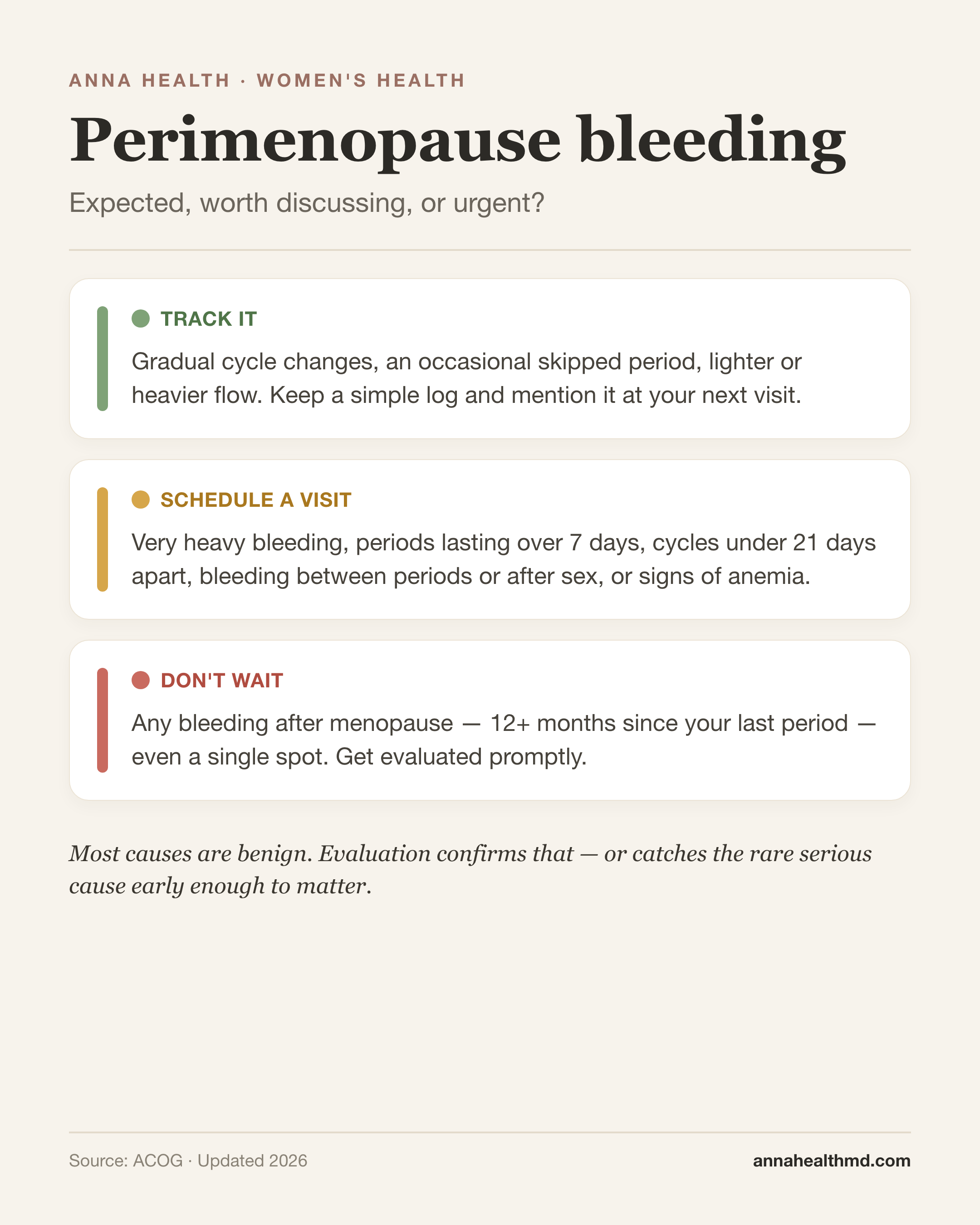
The most useful thing I can give you is a way to sort what you are noticing. Think of it in three tiers.
Green — Track it
Gradual, in-keeping-with-perimenopause changes: cycles drifting longer or shorter, an occasional skipped month, flow that is a little lighter or a little heavier than usual. Keep a simple log — dates and rough flow. You do not need to panic, and you do not need an urgent appointment. You do want to mention it at your next visit so it is on the record.
Yellow — Schedule a visit
These are the patterns worth an appointment, even if you feel fine otherwise. ACOG flags several specifically:
- Very heavy bleeding — soaking through a pad or tampon every hour for several hours in a row
- Periods lasting longer than seven days
- Cycles coming more often than every 21 days
- Bleeding between periods
- Bleeding after sex
- Signs of anemia from blood loss — unusual fatigue, shortness of breath, lightheadedness, a racing heart
None of these means something is definitely wrong. Heavy or frequent bleeding in perimenopause often traces back to benign, very treatable causes — fibroids, polyps, or the hormonal swings of the transition itself. But these are the patterns that earn a proper evaluation rather than a wait-and-see.
Red — Do not wait
Any bleeding after menopause. If you have gone 12 months or more without a period and then bleed at all — even once, even just spotting, even a single pink smear — that is not a late perimenopause hiccup. It is a distinct situation with its own rules, and it deserves prompt evaluation. More on why in a moment.
Why Postmenopausal Bleeding Is a Different Conversation
I want to draw this line as sharply as I can, because it is the single most important idea in this article: perimenopausal irregularity and postmenopausal bleeding are not the same thing, and they are not evaluated the same way.
Irregular bleeding during the transition is expected. Bleeding after menopause — defined as 12 or more months after your final period — is always considered abnormal. Full stop.
Now, the reassuring reality: most postmenopausal bleeding turns out to have a benign cause. Thinning of the uterine lining or vaginal tissue after estrogen drops, polyps, and hormone therapy effects are all common and treatable. Across the research, somewhere in the range of one in ten women with postmenopausal bleeding is ultimately diagnosed with endometrial (uterine) cancer — which means the large majority are not.
But that possibility is exactly why the rule exists. Endometrial cancer is the most common cancer of the female reproductive system, and abnormal bleeding is its most common early sign — in fact, roughly 90% of women diagnosed with endometrial cancer had postmenopausal bleeding as a symptom. When it is caught early, it is one of the more treatable cancers we see. That combination — bleeding is often the first and only sign, and early detection matters enormously — is why "let's just watch it" is not the right answer here. Evaluation is how we confirm the common, benign explanation and rule out the one that can't wait.
What's Changed: ACOG's 2026 Evaluation Guidance
This is where I want to bring you up to date, because the standard of care shifted in 2026, and it is worth understanding.
For years, the approach to postmenopausal bleeding often relied on a transvaginal ultrasound alone. If the ultrasound showed a thin uterine lining (4 millimeters or less), that was frequently considered reassuring enough to hold off on further sampling, because a thin lining has a very high likelihood of being cancer-free.
In April 2026, ACOG published updated guidance that changes this. It now recommends that most patients with postmenopausal bleeding have both a transvaginal ultrasound and an endometrial tissue sample (a biopsy) as part of the initial evaluation — rather than relying on ultrasound alone.
The reason is straightforward and, honestly, patient-protective: newer evidence showed that ultrasound alone can miss a meaningful share of cancers at that first visit — on the order of 5% to 12% — and endometrial cancer rates have been rising. Ultrasound-alone is now reserved for a narrow, lower-risk group: someone with a single episode of bleeding, a fully visualized thin lining, no strong risk factors, and no barriers to prompt follow-up.
What this means for you as a patient is simple: if you are evaluated for postmenopausal bleeding today, do not be surprised if your clinician recommends both an ultrasound and a biopsy from the start. That is not a sign anyone thinks something is seriously wrong. It is the current, evidence-based way to be thorough on the first pass — so you get a clear answer sooner.
What an Evaluation Actually Looks Like
Fear of the unknown keeps people away, so let me demystify it. A workup for abnormal or postmenopausal bleeding is usually straightforward and done in the office:
- A conversation and exam. Your history matters — the pattern of bleeding, your risk factors, medications, and hormone use all shape the plan. There is no single bleeding pattern that diagnoses a cause on its own, which is exactly why the workup exists.
- A transvaginal ultrasound. A painless imaging test that lets us look at the uterine lining and check for things like fibroids or polyps.
- An endometrial biopsy. A quick in-office sampling of the uterine lining. It can cause brief cramping, but it is short, and it gives us the tissue-level answer that imaging alone cannot.
- Sometimes a hysteroscopy. A thin camera used to look directly inside the uterus when we need a closer or more targeted look.
Most people finish this process with a benign explanation and a clear plan — treatment for heavy bleeding, removal of a polyp, an adjustment to hormone therapy, or simple reassurance. The point of the evaluation is not to find something scary. It is to replace uncertainty with an answer.
The Bottom Line
Irregular bleeding in perimenopause is common, and most of the time the change itself is expected. That does not make "normal for your age" a complete answer. Heavy bleeding, bleeding between periods, bleeding after sex, signs of anemia, or any bleeding after menopause all deserve a real evaluation — not to create alarm, but to make sure structural causes, hormone changes, and the health of your uterine lining are looked at properly.
If your bleeding is disrupting your life, or if you are bleeding at all after menopause, please schedule an evaluation rather than waiting it out. That single step is how we confirm the reassuring answer — or catch the rare serious one early enough to matter.
FAQ
My periods are all over the place in my late 40s. Is that automatically a problem?
Usually not. Cycles drifting longer or shorter, skipped months, and changes in flow are hallmark features of perimenopause. Track them, and mention them at your next visit — but they are not, on their own, a reason to worry.
How much bleeding counts as "too heavy"?
A useful benchmark from ACOG: soaking through a pad or tampon every hour for several hours in a row, or periods that last longer than seven days. Bleeding that leaves you fatigued, breathless, or lightheaded is also worth prompt attention, since it can signal anemia.
I only spotted once, months after my last period. Do I really need to be seen?
Yes. Any bleeding 12 or more months after your final period — even a single episode of light spotting — is considered abnormal and should be evaluated promptly. Most causes are benign, but this is the one situation where "wait and see" is not the right approach.
If my ultrasound is normal, why would I still need a biopsy?
Because as of ACOG's 2026 guidance, ultrasound alone can miss some cancers at the first visit. For most patients with postmenopausal bleeding, combining ultrasound with an endometrial biopsy from the start is now the recommended, more reliable way to get a clear answer.
Can you tell what's wrong just from how I'm bleeding?
No — and that is an important point. The pattern of bleeding hints at possibilities, but it does not diagnose a cause by itself. That is exactly why an evaluation, rather than guesswork, is the right next step.